


The UK’s Fire Remediation Programme Is Accelerating – Does the Industry Have the Workforce to Deliver It?
Building safety remediation is moving into a critical period.
Across England, thousands of residential buildings have been identified with unsafe cladding and other life-critical fire safety defects. Government, developers, housing providers and regulators are under increasing pressure to accelerate remediation, while new regional plans are being introduced to identify buildings, remove barriers and get work started sooner.
But accelerating remediation on paper is one thing. Delivering thousands of complex projects safely and to the required standard is another.
Behind every programme sits a practical challenge: does the construction and passive fire protection sector have enough competent people to deliver the work?
The scale of remediation is significant
The latest available Ministry of Housing, Communities and Local Government (MHCLG) monthly figures show the size of the challenge.
At the end of May 2026, 4,411 residential buildings of 11 metres or more had been identified with unsafe cladding and were being monitored through government remediation programmes.
Importantly, the Government estimates that these buildings represent only around 61% to 76% of the total number ultimately expected to require remediation through its programmes.
The developer-led programme alone demonstrates the scale.
As of May 2026, 53 developers had signed the Developer Remediation Contract, covering 4,738 buildings. Of those, 2,604 had been identified as having life-critical fire safety defects that developers are obligated to remediate or pay to remediate.
Only 596 of those 2,604 buildings were reported as having completed remediation at that point.
There has been considerable progress elsewhere. Of the 516 high-rise residential and publicly owned buildings identified with unsafe ACM cladding systems, 500, or 97%, had either started or completed remediation by the end of May 2026, with 472 having completed ACM remediation.
But the wider remediation challenge is far from over.
Government wants remediation to move faster
The Government's Remediation Acceleration Plan was introduced specifically because the pace of remediation was considered too slow.
Its objectives are clear: fix buildings faster, identify buildings with unsafe cladding more quickly and provide greater support to affected residents.
The Government's target is that by the end of 2029, all high-rise buildings of 18 metres or more with unsafe cladding in a government-funded scheme will have been remediated.
For buildings of 11 metres or more, the aim is that by the end of 2029 every building with unsafe cladding will either have been remediated, have a completion date in place, or its landlord will face severe penalties.
Developers have also been pushed towards ambitious milestones. The Government and developers agreed a stretch target for developers to start or complete remediation on 80% of buildings for which they are responsible by July 2026, rising to 100% by July 2027, subject to circumstances outside their control.
That means the pressure to move projects from assessment and planning into physical construction is only increasing.
Remediation is becoming a regional priority
One of the most significant developments has been the creation of Local Remediation Acceleration Plans.
All 12 Mayoral Strategic Authorities have now published plans designed to bring together local authorities, regulators, fire and rescue services and other organisations to accelerate remediation in their areas.
These include the East Midlands, Greater Manchester, Liverpool City Region, London, North East, South Yorkshire, West Midlands, West Yorkshire and West of England, among others.
London demonstrates just how concentrated the challenge can be.
When London's Local Remediation Acceleration Plan was announced in June 2026, there were 1,078 buildings in government remediation schemes in London where work had yet to commence as of April 2026. That was more than all other English regions combined.
As programmes accelerate across different regions at the same time, competition for experienced contractors and workers could become increasingly important.
The challenge isn't just money. It's people.
Funding, legislation and enforcement can help projects move forward, but none of them physically deliver remediation work.
That requires people.
And concerns about workforce capacity aren't hypothetical.
The Public Accounts Committee previously warned that insufficient capacity and skills across regulators, local authorities and the construction sector risk undermining remediation acceleration plans. The Government accepted the recommendation that action was needed to increase capacity and skills across the building sector.
Greater Manchester's own Remediation Acceleration Plan also highlights a lack of resources, workforce and relevant skills as a potential barrier and calls for consideration of capacity across the construction sector and its associated supply chains.
Even the Building Safety Regulator has been expanding capacity. In April 2026, the BSR announced an external remediation improvement plan that included a recruitment drive designed to reduce regulatory lead caseloads from an average of around 25 to approximately 10.
The issue therefore stretches across the entire remediation system.
Where passive fire protection fits into the picture
Cladding is understandably at the centre of much of the Government's remediation programme, but effective building fire safety goes much further than the external wall.
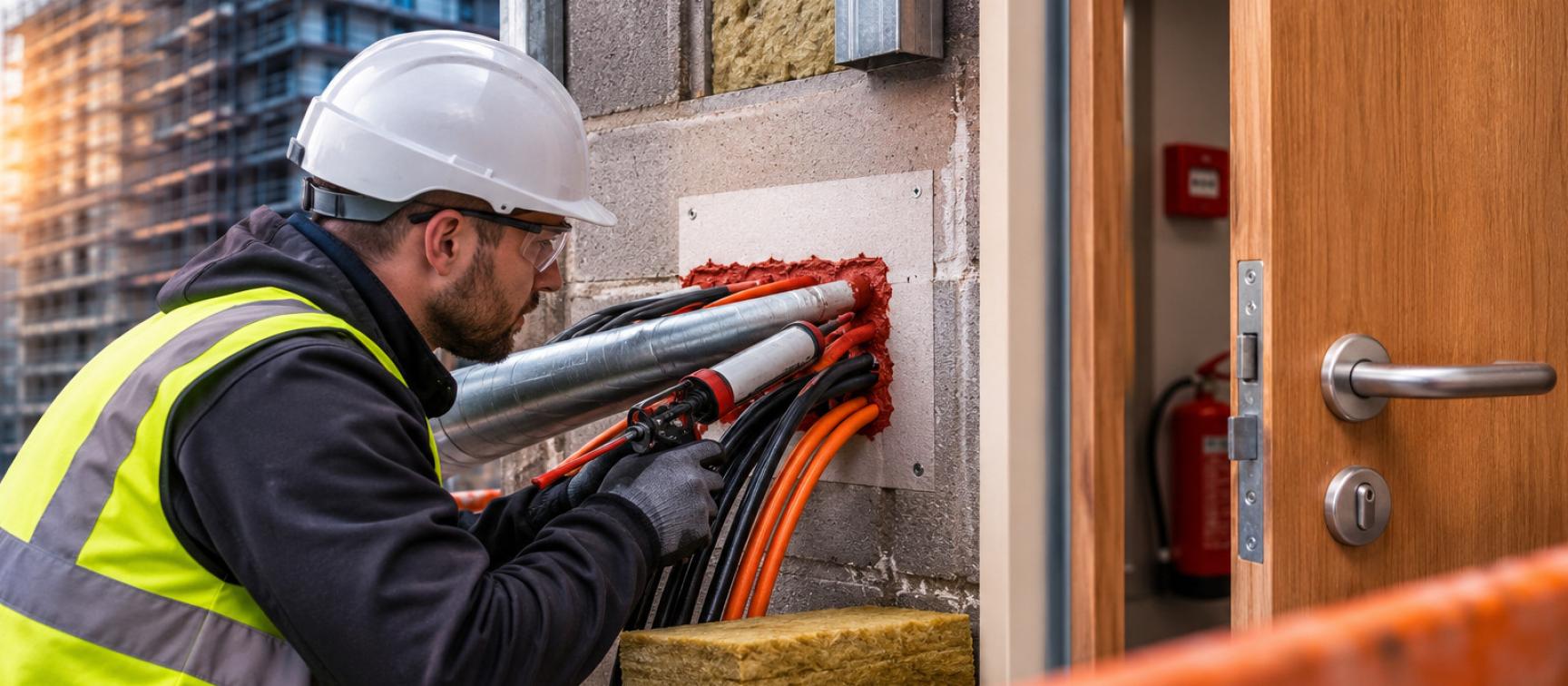
Passive fire protection is designed to restrict the spread of fire and smoke through a building, helping to maintain compartmentation and providing occupants with valuable time to escape.
Depending on the building and scope of work, this can involve areas such as:
- Fire stopping
- Fire-resistant walls and floors
- Fire doors and doorsets
- Service penetration sealing
- Cavity barriers
- Fire-resistant ductwork
- Structural fire protection
- Inspection and remediation of existing passive fire systems
Remediation work can also uncover issues that weren't necessarily obvious when the original project scope was developed.
Opening up areas of a building may expose defective or missing fire stopping, poorly protected penetrations, compartmentation issues or historic work that no longer meets the required standard.
This is why the competence of the people carrying out, supervising and inspecting passive fire protection work matters.
Speed cannot come at the expense of quality
There is an obvious tension within the remediation programme.
Buildings need to be made safe faster, but accelerating delivery cannot mean compromising the quality of the work.
Remediation projects can involve occupied residential buildings, complex interfaces between trades and extensive evidence and record-keeping requirements.
Passive fire protection is also an area where apparently minor installation errors can have significant consequences.
Using the correct product is only part of the process. Systems need to be installed correctly, in the correct location and in accordance with the appropriate specification and manufacturer's instructions.
That places greater importance on competent operatives, experienced supervisors and managers who understand the work they are responsible for.
The challenge for contractors therefore isn't simply:
"How many people can we get on site?"
It is increasingly:
"How many suitably experienced and competent people can we get on site when we need them?"
Competition for experienced workers could increase
As more remediation projects move towards construction simultaneously, the same contractors may find themselves competing for a relatively limited pool of experienced workers.
Depending on individual projects, demand may include:
- Fire stoppers
- Fire door installers
- Carpenters and joiners
- Passive fire supervisors
- Site managers
- Contracts managers
- Project managers
- Quantity surveyors
- Inspectors and compliance professionals
The problem becomes particularly acute when programmes change at short notice.
A contractor may have the permanent management structure to deliver a project but suddenly require additional site labour following an accelerated programme, a new phase of work or an increase in workload.
Waiting until the requirement becomes urgent can significantly reduce the available talent pool.
Workforce planning needs to happen earlier
For passive fire contractors, the growth of remediation activity makes workforce planning increasingly important.
Businesses that know they have projects starting in the coming months should be considering labour requirements alongside programme planning rather than treating recruitment as something that begins immediately before mobilisation.
Questions worth asking include:
Where are our projects likely to be concentrated?
If several projects are running within the same region, establishing a reliable local workforce can reduce dependence on workers travelling long distances.
Which skills are likely to become difficult to secure?
Specialist experience can be harder to find than general construction labour, particularly when several contractors are recruiting from the same talent pool.
Where could temporary labour provide flexibility?
Remediation workloads aren't always predictable. Temporary recruitment can allow contractors to increase or reduce resources as projects move through different stages.
Are we assessing experience as well as availability?
In passive fire protection, simply filling a position isn't enough. Relevant experience, qualifications, references and competency requirements need to form part of the recruitment process.
2026 could be an important year for the sector
The direction of travel is clear.
Government wants unsafe buildings identified sooner. Regulators are being given greater responsibility for enforcement. Regional authorities are implementing their own acceleration plans. Developers are being pushed to move buildings through remediation faster.
That creates a substantial pipeline of work for the construction, remediation and passive fire protection sectors.
But it also creates a capacity challenge.
The success of the UK's remediation programme will ultimately depend not only on policy and funding, but on whether there are enough competent contractors, managers, supervisors and skilled operatives available to turn those plans into safe, completed buildings.
For passive fire protection businesses, workforce planning therefore needs to become part of project planning.
Supporting the Passive Fire Protection sector
Approach Personnel works with contractors across the UK, providing temporary and permanent recruitment support across construction and Passive Fire Protection.
From individual site requirements to additional teams needed to support growing project pipelines, our recruitment teams can help contractors access experienced workers when and where they're required.
With remediation activity expected to remain a major part of the UK construction landscape for years to come, building a reliable workforce will be essential.
If you have upcoming Passive Fire Protection or remediation projects and need support securing the right people, speak to Approach Personnel about your requirements.