


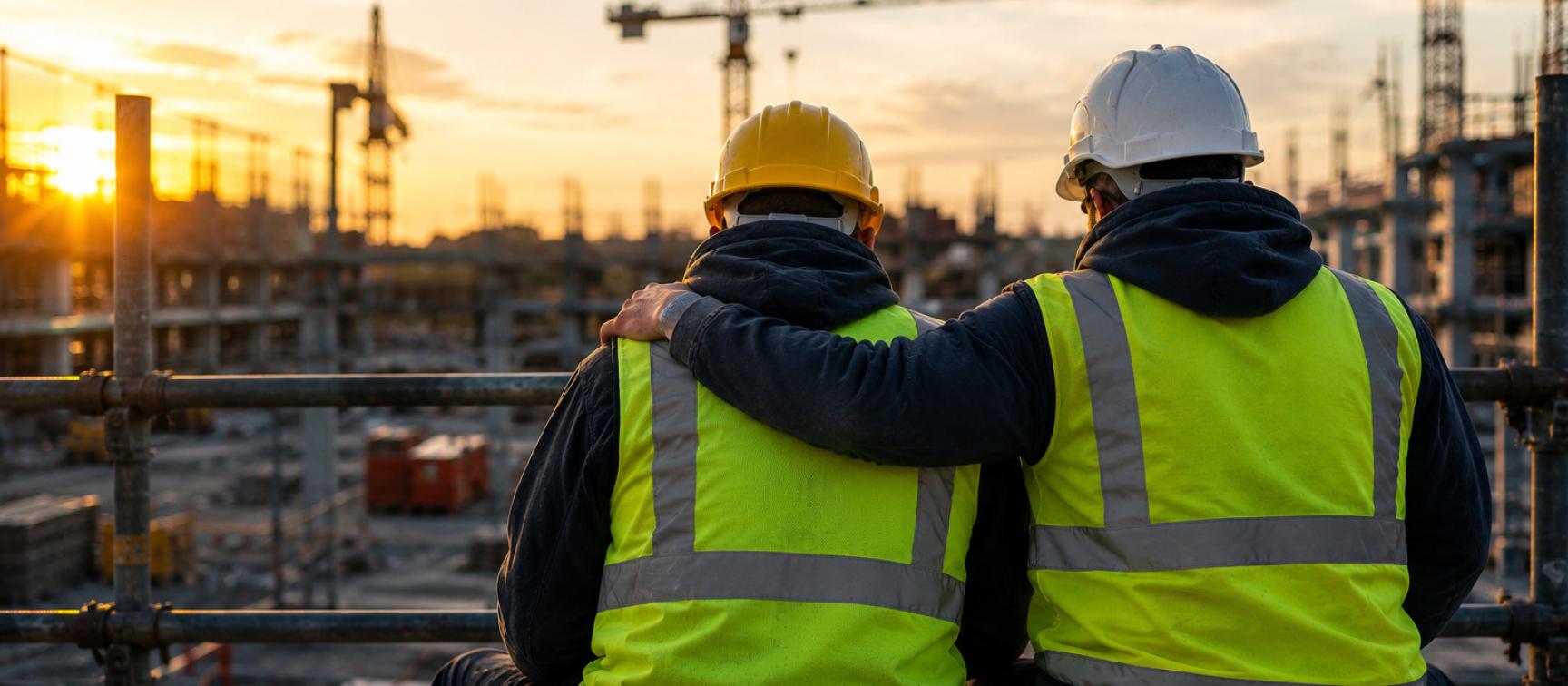
Suicide Awareness Month 2026: It’s Time for Construction to Talk
September is Suicide Awareness Month, with World Suicide Prevention Day taking place on 10 September.
For the UK construction industry, this is a conversation that cannot be limited to one day or one month.
Construction is an industry built on people. Every day, thousands of workers turn up on sites across the country, often working long hours, away from their families and under significant physical and financial pressure.
But behind the hard hats, hi-vis jackets and site banter, some people are struggling in ways that those around them may never see.
At Approach Personnel, we work with construction professionals and tradespeople across the UK every day. This September, we want to help raise awareness of an issue that continues to affect our industry at a devastating level.
The figures behind the conversation
The latest full Office for National Statistics figures show that 6,190 suicides were registered in England and Wales in 2024, equivalent to 11.4 deaths per 100,000 people.
Men continue to be disproportionately affected. The male suicide rate in 2024 was 17.6 deaths per 100,000, compared with 5.7 per 100,000 for women.
More recent provisional ONS figures show that 5,728 suicides were registered in England alone during 2025, with the overall rate remaining at 11.1 per 100,000.
But when we look specifically at construction, the statistics become even more concerning.
Historic ONS occupational analysis found that low-skilled male construction workers had a suicide risk 3.7 times higher than the male national average. Men working in construction and building trades were also at elevated risk, with roofers, tilers and slaters among the occupations identified as particularly vulnerable.
More recent industry analysis found that 507 suicides were attributed to construction occupations in 2021 – 503 of them men. This equated to approximately 34 deaths per 100,000 construction workers, up from 26 per 100,000 seven years earlier.
In April 2026, the ONS also published an updated dataset specifically covering suicide deaths among construction workers in England and Wales between 2011 and 2024, demonstrating why suicide within construction remains an issue demanding sustained attention. The ONS cautions that raw numbers alone should not be used to compare occupational risk because the size and demographics of different workforces vary.
These aren't simply statistics.
They represent colleagues, employees, subcontractors, friends, partners, parents, sons, daughters and members of our construction community.
Why can construction workers be particularly vulnerable?
There isn't one single explanation for suicide, and we should be careful not to suggest there is.
However, construction can bring together several pressures that can make life particularly difficult.
Workers may face periods of insecure employment, financial pressure, working away from home, long hours, physically demanding work and uncertainty about where the next project will be.
There is also a culture within parts of the industry where people can feel pressure to appear tough and simply "get on with it".
That culture is changing – but there is still work to do.
For somebody already dealing with relationship problems, bereavement, debt, addiction, loneliness, anxiety, depression or difficulties outside work, additional workplace pressures can sometimes become overwhelming.
And one of the biggest barriers can simply be talking about it.
Ahead of World Suicide Prevention Day 2026, Samaritans reported that only 45% of people feel comfortable talking to family and friends about suicidal thoughts, compared with 74% who feel comfortable discussing mental health more generally.
That gap matters.
Starting a conversation could make a difference
You don't need to be a mental health professional to check in with somebody.
Sometimes it can start with something as simple as:
"How are you doing?"
And if the automatic response is "I'm fine", asking again can make all the difference:
"No, seriously – how are you?"
If someone seems different from normal, has become withdrawn, appears unusually angry or emotional, isn't looking after themselves or simply doesn't seem like themselves, don't be afraid to reach out.
You don't need to have all the answers.
You can listen.
You can give them space to talk.
And you can help them find professional support.
Samaritans specifically encourages people not to be afraid of talking openly about suicidal feelings when they're concerned about someone. Asking about suicide does not put the idea into somebody's head; instead, it can provide an opportunity for someone who is struggling to talk about what they're experiencing.
Construction is beginning to change
There is encouraging work already happening throughout the industry.
The Lighthouse Construction Industry Charity, for example, provides emotional, physical and financial wellbeing support to construction workers and their families.
During 2024 alone, its helpline advisers and caseworkers provided £4.98 million of charitable support to 5,695 families, alongside 5,756 counselling sessions.
Its #MakeItVisible team also visited 572 construction sites, speaking to more than 28,000 site workers. During those visits, 88 workers who expressed suicidal thoughts were introduced directly to the team for support.
That shows why taking support directly onto construction sites matters.
Mental health conversations shouldn't only happen in boardrooms, HR meetings or awareness campaigns.
They need to happen in site cabins, vans, canteens, offices and between colleagues.
What can construction employers do?
Creating a mentally healthier construction industry requires more than putting a poster on the wall during September.
Businesses can make a meaningful difference by training managers and supervisors to recognise changes in behaviour, promoting confidential support services, introducing mental health first aiders, regularly checking in with workers and ensuring conversations about wellbeing become part of everyday site culture.
Managers should also recognise that someone's circumstances can change quickly.
A worker who appeared completely fine last week may be dealing with something entirely different today.
Most importantly, businesses need to create an environment where asking for help is viewed as a strength rather than a weakness.
Looking out for the people behind the PPE
Recruitment gives us a unique position within construction.
At Approach Personnel, our consultants speak to construction workers across the UK every day – from labourers and plant operators through to site managers, quantity surveyors, project managers and senior construction professionals.
We talk about rates, projects, start dates, qualifications and experience.
But sometimes the most important conversation has nothing to do with work.
September's Suicide Awareness Month is an opportunity for all of us – recruiters, contractors, subcontractors, clients, managers and colleagues – to think about the people working alongside us.
Check on your colleagues.
Check on the person who's gone unusually quiet.
Check on the person who always seems happy.
Check on the person who hasn't seemed themselves lately.
And don't assume somebody else will do it.
A conversation might feel small to you. To somebody who is struggling, it could mean everything.
Where to get help
If you or somebody you know is struggling, support is available.
Samaritans: Call 116 123 free, 24 hours a day, 365 days a year.
Lighthouse Construction Industry Charity: Specialist emotional, physical and financial wellbeing support is available for people working in construction and their families.
If someone is in immediate danger or there is an immediate risk to life, call 999 or go to A&E.
This September, let's keep talking.
Let's make it normal to ask twice.
And let's continue working towards a construction industry where nobody feels they have to struggle alone.
Recent News
The Skills Shortage in Construction: Could Armed Forces Veterans Be Part of the Solution?
Labour’s New 2.5% Deposit Scheme: What Could It Mean for the UK Housing and Construction Market?
Modular Construction Doesn’t Eliminate Site Labour: It Changes Where Skills Are Needed